Most of the conversation about AI and early-career work is really a conversation about one skill. Teach juniors to write good prompts. Teach them which tool to reach for. Teach them to check the output. Call it AI literacy, put it in the onboarding deck, and move on. It is a useful skill. It is also a surprisingly small part of what is actually changing.

I have spent two months interviewing senior consultants about what AI changes for the juniors they supervise. The study is ongoing, around a dozen interviews in. When I lay the interviews side by side, coaching juniors to use the tool well is one of five things these supervisors are doing. Just one. And it is not the one they talk about most.
The reason is a deeper change that AI literacy does not touch. For most of the history of professional work, a polished deliverable was proof of something. You could not produce a good answer without understanding it first. The struggle to make the artifact was the learning. Generative AI breaks that link. A junior can now produce work that looks expert without the expertise that used to sit behind it. Performance has come loose from competence.
So a clean deck no longer tells a supervisor what it used to. The thing they were trained to inspect has gone quiet. Nobody handed them a new method. They are improvising one, and those improvisations sort into five families that cover far more ground than prompting.
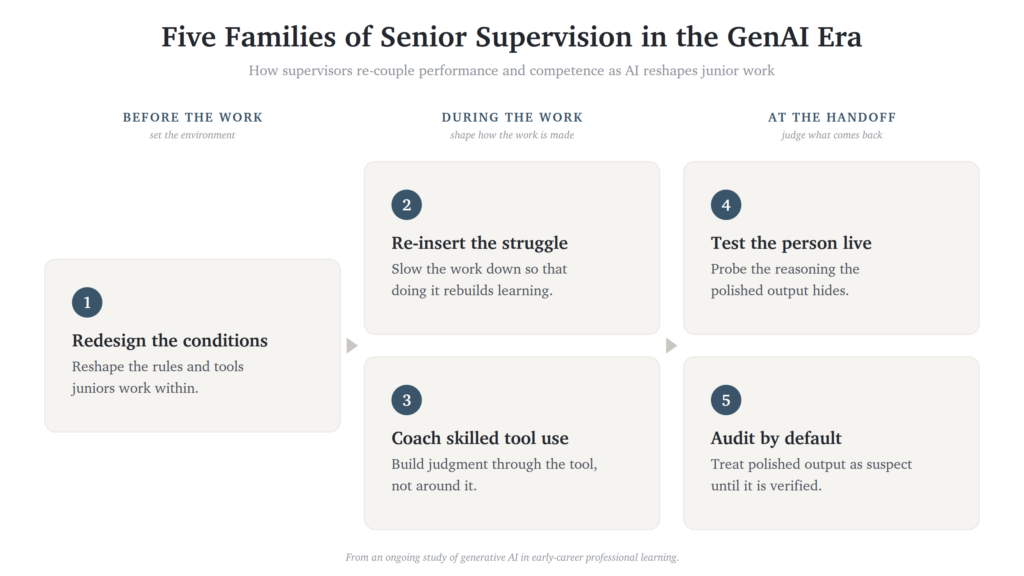
The five families group into three moments: before the work, during the work, and at the handoff.
You can get the perfect answer. But what did I just learn? I don’t know, because I didn’t think at all.
Digital transformation consultant
Before the work
Redesign the conditions. The first family never touches a single piece of work. It changes the environment the junior works in. Some firms have stopped letting juniors use public AI tools and built private models trained on their own past projects, so the tool is bounded by the firm’s own knowledge. Others have made AI training mandatory and tiered, bronze through platinum, with the badge tied to promotion. The logic is simple. Before you fix how a junior works, fix what they work with.
During the work
Re-insert the struggle. The second family runs against the whole promise of the tool. AI removes friction, and these supervisors deliberately put it back. The clearest version is the bullet-point rule. Juniors may not generate prose first. They draft the argument as bare bullet points, defend it out loud, and only then bring AI in. Other supervisors work through verification. When a junior leans on AI to build a model, they must then open the original specification and trace the logic by hand. The mistake becomes one they find, not one they are told about.
Coach skilled tool use. The third family is the one the AI-literacy conversation is really about, and it is sharper than that conversation usually is. The shift is from AI as a fast typist to AI as a sparring partner. Juniors are taught to hand the tool their own draft and ask it to attack the approach, not to produce it. One managing director makes trainees ask the AI twenty hard questions about a problem, as practice in what a good question even is. Used that way, the tool builds judgment. Used as an answer machine, it quietly replaces it.
I can summarize it too. So why am I paying $500 an hour for you to run it through AI?
A client, recounted by a senior consultant
Five families, not a law
One honest note. These are five families drawn from a study still in progress, not a finished framework. Some showed up in many interviews and some in only a few. The boundaries between them are softer than five tidy boxes suggest, and a single supervisor often uses three of them in a week without naming any.
What strikes me most is not any single practice. It is that almost every supervisor invented their own response alone, with no shared playbook, and each one assumed it was just them. The practices are real. That nobody is comparing notes is the actual finding.
A junior using AI just gets what he sees. A senior using AI knows what he is looking for.
Innovation consultant
If you supervise juniors
I am still interviewing, and the picture is far from complete. If you review the work of early-career colleagues and you have changed how you do it, I would like to hear what you changed. It is a 45-minute conversation, confidential, with no firm or client names, and I am glad to share an anonymized summary of the findings afterwards. Get in touch.