If you teach information systems, enterprise architecture or digital transformation, this role-play gives your students a real AI adoption decision to argue about in 30 minutes. It is built on a recent case about the Siemens electronics plant in Amberg, and all the materials are free to download at the end of this post.
I ran it this week with groups of five in my Enterprise Architecture class at Ghent University.
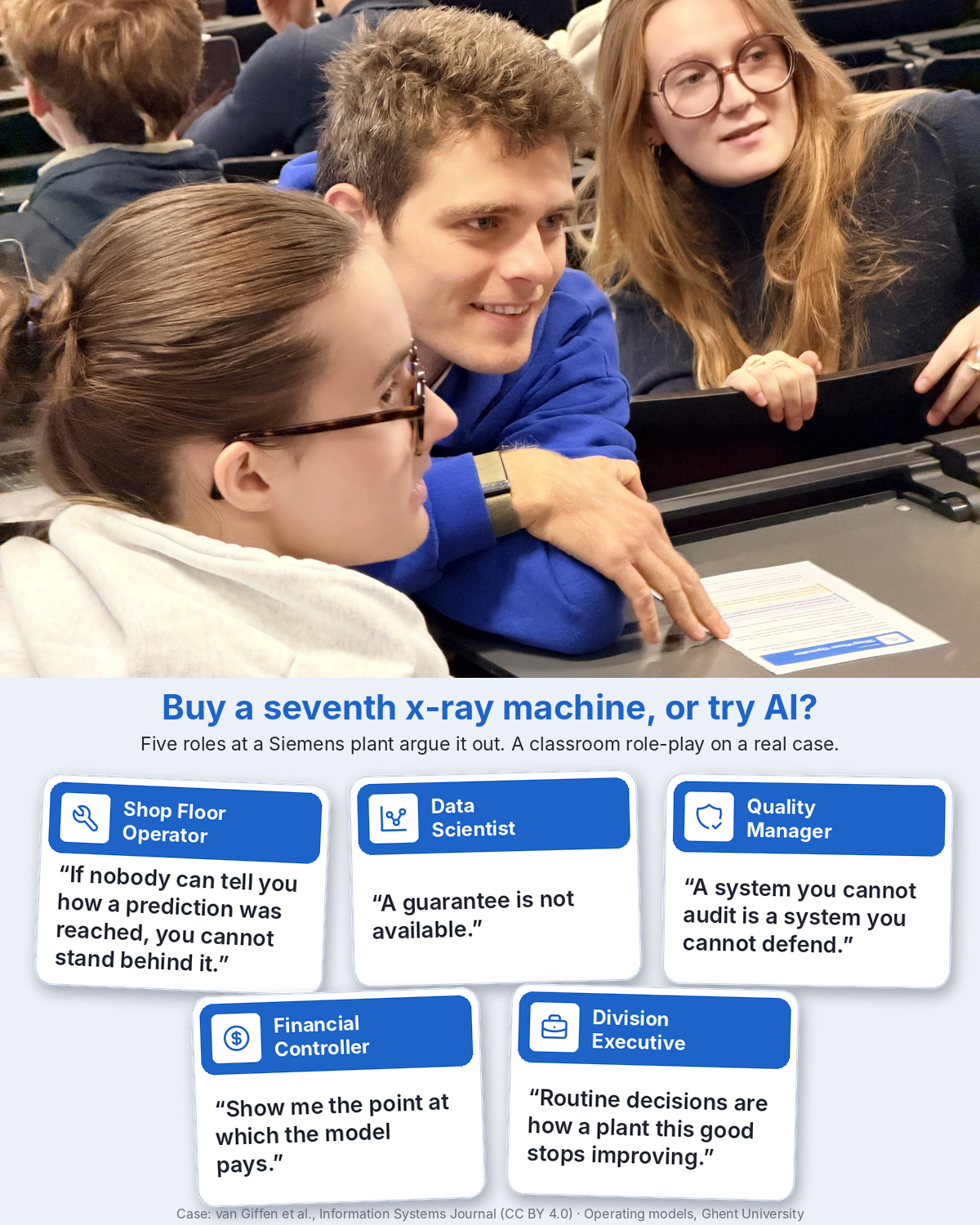
The decision on the table
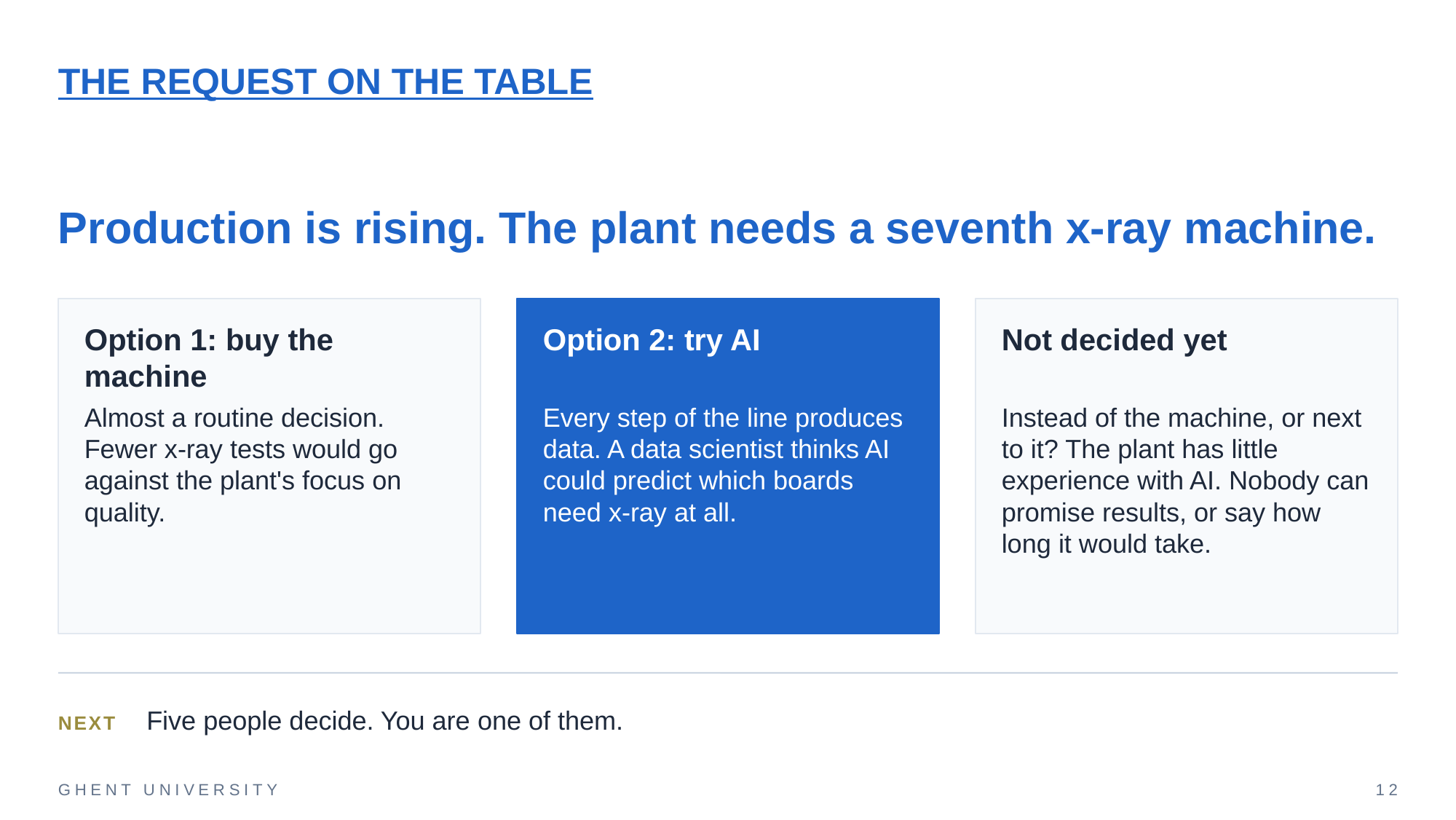
Siemens Electronics Works Amberg makes about a million SIMATIC controllers a month and runs on lean quality management. Production is rising, and the x-ray inspection line needs a seventh machine at roughly €500,000. Buying it is almost a routine decision. Then a data scientist suggests that AI could predict which boards need an x-ray at all.
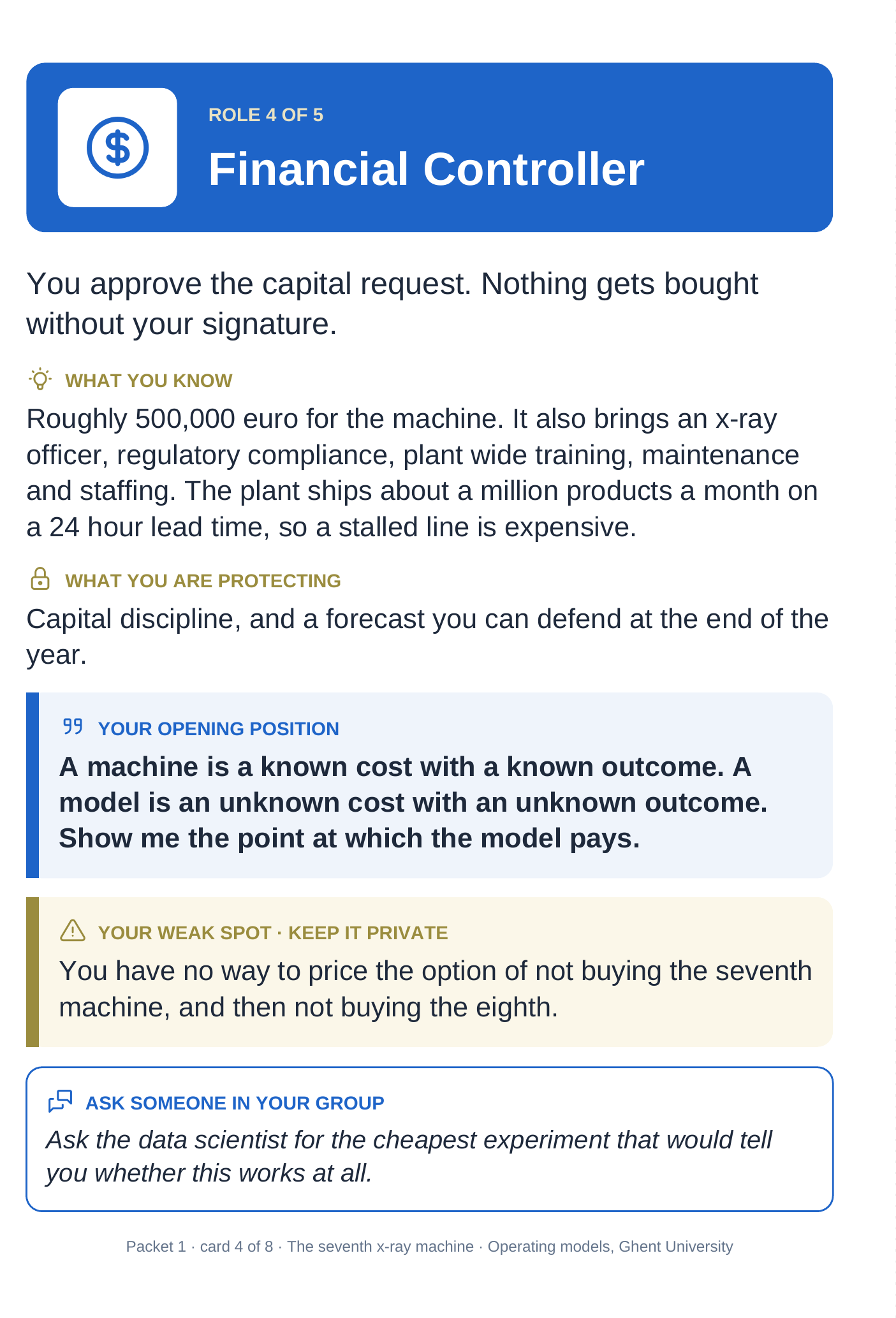
Five roles, five private cards
Each group of five gets a packet of eight cards. There is a cover, a rules card, an agenda card and one role card per person: the Shop Floor Operator, the Data Scientist, the Quality Manager, the Financial Controller and the Division Executive. A role card tells you who you are, what you know, what you are protecting and where you start. It also gives you a weak spot to keep private and a question to put to someone else in your group.
Procedure of the role-play
- Read for 2 minutes. Each person reads only their own card.
- Argue for 10 minutes, in role.
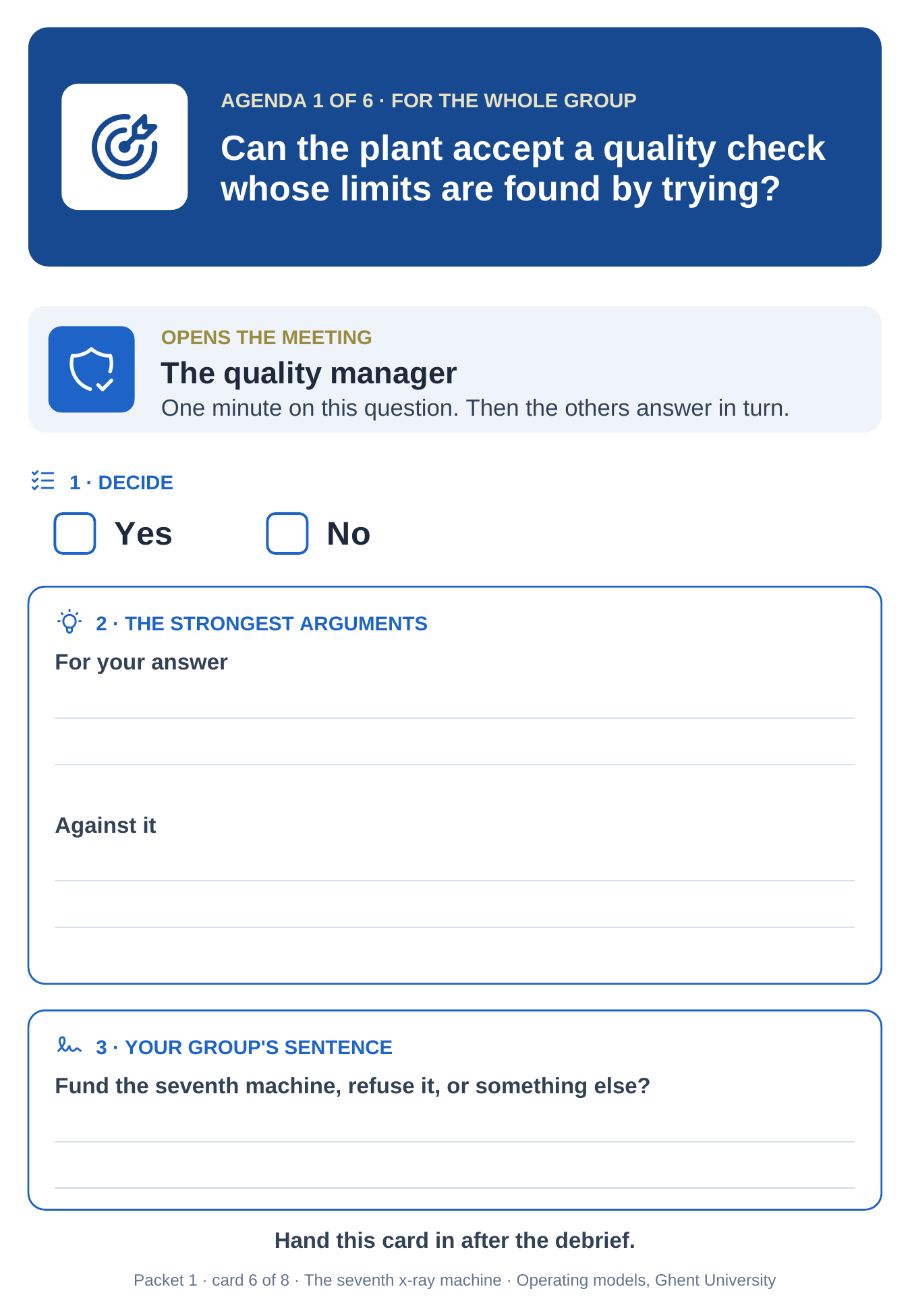
- Write. The group answers one yes-or-no question on its agenda card and leaves with one sentence: fund the machine, refuse it, or propose something else.
- Debrief with the whole class.
There are six agenda cards, each with a different question. With several groups in the room, the debrief brings together six different arguments about the same plant.
Why students enjoy it
Everyone has a stake. Five roles for five people means nobody can sit back and watch.
The cards hold secrets. Each role has a weak spot it must keep private, and the others try to find it.
The rules allow disagreement. Students are told not to break character to be reasonable. The disagreement is the point.
Nobody knows the ending. Groups stand at the moment of decision, and nothing after it is available to them. Each group’s sentence is its own.
It is short. Two minutes of reading and ten of arguing keep the energy up.
What it helps teach
AI adoption is an organizational decision. A quality culture, customers who pay for x-ray certificates, a capital budget and a rising order book all pull on one purchase.
Lean and machine learning rest on different assumptions. Lean assumes the right process can be written down in advance. A model finds its limits by trying. Students feel this tension in the argument before they have a name for it.
Decision rights matter. Students have to work out who approves the money, who can stop the project alone, and who sets the limits of a system that learns. The agenda cards put questions like these to the groups directly.
It opens the theory. In my class the debrief leads into a lecture on operating models and on how firms organize IT. The groups’ own arguments become the examples.
Download
Print each packet double-sided and cut the sheets in half into A5 cards. Print one test sheet first to check the flip edge. You need one packet per group of five. In a group of six, two people share one role card.
- Packet, agenda 1 (PDF)
- Packet, agenda 2 (PDF)
- Packet, agenda 3 (PDF)
- Packet, agenda 4 (PDF)
- Packet, agenda 5 (PDF)
- Packet, agenda 6 (PDF)
- Facilitation sheet (PDF)
- README (TXT)
- All files as one zip
The materials are shared under CC BY 4.0. Use them and adapt them in your own teaching, and please credit the paper and this role-play.
Source
The case comes from an open access paper. My thanks to the authors for writing a case with this much detail. It gave every role something real to argue about.
van Giffen, B., Beitinger, G., Ludwig, H., Schiano, B., Schmidt, K., & vom Brocke, J. The Culture Clash of AI Adoption in Lean Quality Management. Resolving the Tensions at Siemens Electronics Works Amberg. Information Systems Journal. https://doi.org/10.1111/isj.70006
If you run it in your class, I would love to hear what your groups decided.