A colleague told me he is not convinced AI will ever do good ArchiMate. So I went to work to see if I prove him wrong 🙂 What came out is a Claude skill that builds valid ArchiMate models through conversation. You can come to it with a vague idea, it keeps asking you for more and more details on what you want to model, and what comes back is a file Archi opens. It also explains how your answers help refine the models as you go.
Add it in Claude under Settings, Capabilities, Skills. Upload the zip as it is, no unzipping. Nothing installs on your machine.
What it does
The skill holds all 2,348 relationship pairs from the ArchiMate 3.2 specification plus Archi’s own rules, so it cannot draw a relationship the standard forbids. Everything it writes is checked against the Open Group schema before it is rendered.
It also checks the reasoning. A model can pass every rule and still say nothing true. So it reads each element name against the specification definition of its type, and reads the whole model back as sentences to see whether the story holds. Services nothing realizes. Processes nobody performs. Goals nothing achieves. Those come back to you as questions.
Composition and aggregation are drawn as nesting, the way Archi does it, which is what keeps a model readable once it grows. The exported Open Exchange file carries that nesting into Archi intact.
Three strictness levels come across from ArchiTrek:
- Academic, for teaching and reference models. Shortcuts and layer skips are errors you have to model out.
- Pragmatic, for working models. The same issues arrive as warnings you judge in context.
- Discovery, for early sketching. Only the hard rules apply, so a rough draft is not buried in findings.
The level changes how loudly it complains. The rules stay the same at all three.
How it works
The whole thing is one loop that runs until nothing is left unasked.
It asks a question and says why it is asking. You answer, or you argue with the framing, which is why the reason comes before the question is answered. The rules then reject anything that cannot be true, which is the mechanical part and has no opinion in it. Finally it reads the model back as sentences, and a wrong name, a wrong type or a story that does not hold becomes the next question. Round again.

Worth noticing where the labour divides. Judgement sits on both sides of the lookups. Choosing which element type fits happens before the tables ever see the relationship, and reading the story happens after the checks have run. The lookups can only reject what judgement proposes. They never propose anything themselves.
How you use it
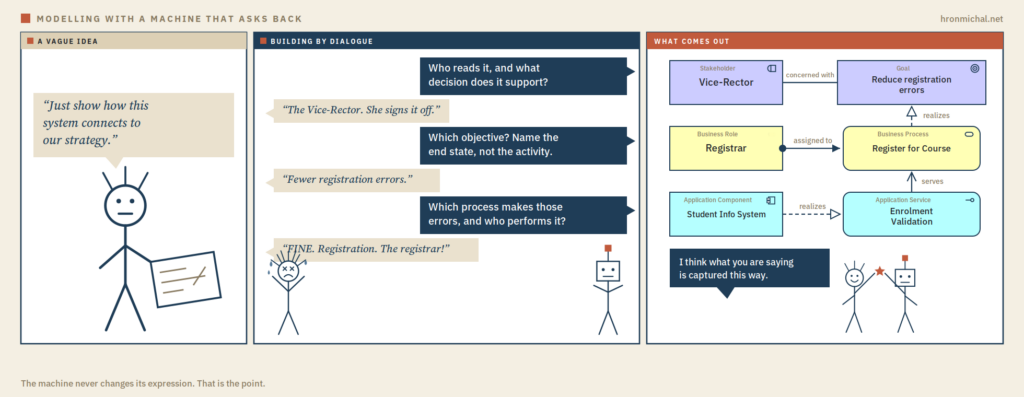
Bring it something vague. I was handed this solution diagram and I need to show how it relates to our strategic objectives.
Then it asks. Who reads this diagram. What decision it supports. Which objective, phrased as an end state and not an activity. Who performs the process. What realizes the service. Every question comes with what your answer will decide in the model.
When an answer lands in the wrong category it says so. Ask for a goal and people often give a route. Migrate everything to the cloud is a Course of Action. The skill keeps that answer under its real type and asks what will be true when it has worked, which is the goal you were after.
You see a sketch before anything is committed, and nothing is written until you approve it.

What it cannot do
Back to the colleague. The syntax half needed a bit of work and no invention, because I had already digitised the relationship tables for ArchiTrek, my ArchiMate navigator, and wrote about why those tables are so hard to use by hand. Reusing them meant the skill could not produce an illegal relationship on day one.
The other half is not solved. It cannot know whether the Registrar really performs that process, or whether reducing registration errors is what your Vice-Rector actually cares about. It asks good questions and it finds holes in the story. Whether the picture is true stays your call, which is why the loop ends with your approval and not the validator’s.
If you teach enterprise architecture and want to try it on a cohort, or you have watched students hand in models that pass every rule and say nothing, tell me how it lands.