Most strategy tools tell you what an ecosystem looks like. Far fewer tell you what to do when you are trying to start one. This is a short note about a small tool I built to sit in that gap. It is a deck of eight cards.
The pie model maps structure, not formation
When several organizations want to build something together, they form an ecosystem. A municipality, a second-hand store, a repair café, a community app, and a group of residents might all need each other to make local sharing work. To plan this, people often reach for a mapping framework. The one I use most is the Ecosystem Pie Model by Talmar and colleagues.1 It is a good tool. You place each actor in a slice and describe what they bring, what they take, and how much they depend on the whole. By the end you can see the structure of the ecosystem on one page.
A recent paper formalizes the EPM as a complete design theory.2 It covers constructs, design principles, a visual interface, application guidelines, and a body of over 240 ecosystem models. That work makes one thing clear: the EPM is built for structural risk assessment. It asks whether the actors needed for a value proposition are willing and able to deliver their part. It does not ask how you get those actors to the table in the first place.
But structure is not the same as formation. A map shows you the ecosystem as if it already exists. It says little about the harder question: how do you bring a group of independent actors to commit to something that does not yet exist? Research on ecosystem emergence and leadership has moved toward exactly this question over the last decade.3, 4 That work rarely makes it into a workshop room. It stays in journal articles.
Research on ecosystem emergence, put on cards
The cards carry that research into the room. I read through the literature on ecosystem emergence and pulled out the advice that kept recurring. Each piece became a short principle. Each principle went on a card. A card says: to design a viable ecosystem, take steps to do this, because the research suggests it helps.
The theoretical backbone draws on four strands of research: ecosystem legitimacy,3 maneuvering under uncertainty,5 navigating cooperation and competition in nascent ecosystems,6 and role dynamics in ecosystem emergence.7
Four pairs of cards that contradict each other
Here is the part I find most interesting. The cards come in four pairs, and the two cards in each pair contradict each other.
Table 1. Four paradoxical pairs of design principles for ecosystem initiation. Each pair is drawn from the literature on ecosystem emergence.
This is not a flaw in the deck. It is the design. The research genuinely supports both sides of each tension. A card is not an instruction to follow. It is a prompt to think with. When a group draws “create urgency” and “signal long-term commitment” in the same session, the useful work is the discussion of how to hold both at once. Designers do not apply principles the way an engineer applies a formula. They use them as stimulation, as a way to notice an aspect of the problem they had missed.8 The paradoxical pairs make that stimulation explicit.
One hour: map first, then draw cards
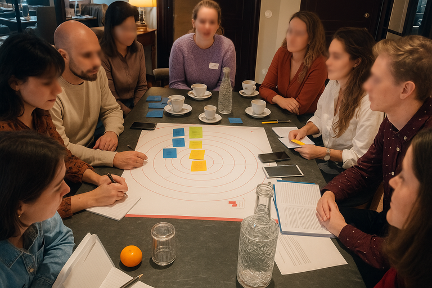
The workshop runs for an hour. In the first half, the group maps their ecosystem with the pie model. They name the actors and describe the slices. In the second half, they draw cards. A facilitator reads a card aloud, and the group discusses how that approach would change the ecosystem they just mapped. The cards keep the conversation moving and stop it from settling too early.
Seven municipalities tested the deck in Sweden
I tested the deck with seven European municipalities working on local sharing initiatives as part of the Digital Kiosks project, at a consortium meeting in Sweden. About 25 participants split into three cross-municipal groups. Two things stood out.
The first is that the discussion is lively with or without the cards. Once a group names its actors, people start drawing arrows and arguing about relationships on their own. The cards add direction to that energy rather than creating it.
The second is that some cards were not clear. The urgency card was the main offender. Groups kept asking “urgent for whom?” An ecosystem does not always share a sense of common purpose, so urgency at the ecosystem level can feel abstract. The dependence card was sometimes read as enthusiasm rather than actual reliance on the ecosystem. So the deck went through a revision. That is the normal life of a small tool. You build it, you watch people use it, and you fix what confused them.
After the workshop, participants rated each pair on understanding, insightfulness, and usefulness (n=12, 5-point scale):
Table 2. Workshop evaluation results. Participants rated each pair on understanding, insightfulness, and usefulness (n=12, 5-point Likert scale).
Looking for more workshops to validate the principles
A paper on the design principles behind the cards is in progress. The first round of testing gave useful signal on clarity and usefulness, but the deck needs more exposure to different settings. I am looking for workshop contexts where I can retest and further validate the principles. These could be ecosystem design sessions, partnership workshops, accelerator programs, or strategy offsites where multiple organizations try to build something together. Different contexts help surface which principles hold up, which confuse, and which are missing entirely. If you run something like that and want to try the deck, get in touch. I am glad to share the materials and learn from your experience with them.
References
1 Talmar, M., Walrave, B., Podoynitsyna, K.S., Holmström, J., & Romme, A.G.L. (2020). Mapping, analyzing and designing innovation ecosystems: The Ecosystem Pie Model. Long Range Planning, 53(4), 101850.
2 Talmar, M., Holmström, J., Romme, A.G.L., Walrave, B., & Podoynitsyna, K. (2025). Creating and applying the Ecosystem Pie Model as a design theory. Journal of Business Venturing Design, 4, 100030.
3 Thomas, L.D.W., & Ritala, P. (2022). Ecosystem legitimacy emergence: A collective action view. Journal of Management, 48(3), 515–541.
4 Foss, N.J., Schmidt, J., & Teece, D.J. (2023). Ecosystem leadership as a dynamic capability. Long Range Planning, 56(1), 102270.
5 Dattée, B., Alexy, O., & Autio, E. (2018). Maneuvering in poor visibility: How firms play the ecosystem game when uncertainty is high. Academy of Management Journal, 61(2), 466–498.
6 Hannah, D.P., & Eisenhardt, K.M. (2018). How firms navigate cooperation and competition in nascent ecosystems. Strategic Management Journal, 39(12), 3163–3192.
7 Kortus, L., Gutmann, T., & Kreutzer, M. (2025). Unearthing role dynamics within innovation ecosystem emergence. R&D Management.
8 Kruse, L.C., Purao, S., & Seidel, S. (2022). How designers use design principles: Design behaviors and application modes. Journal of the Association for Information Systems, 23(5), 1235–1270.